

Articles written for the Lanzarote Gazette between 2006-25:
TREE WISDOM – October 2025 – see online article here
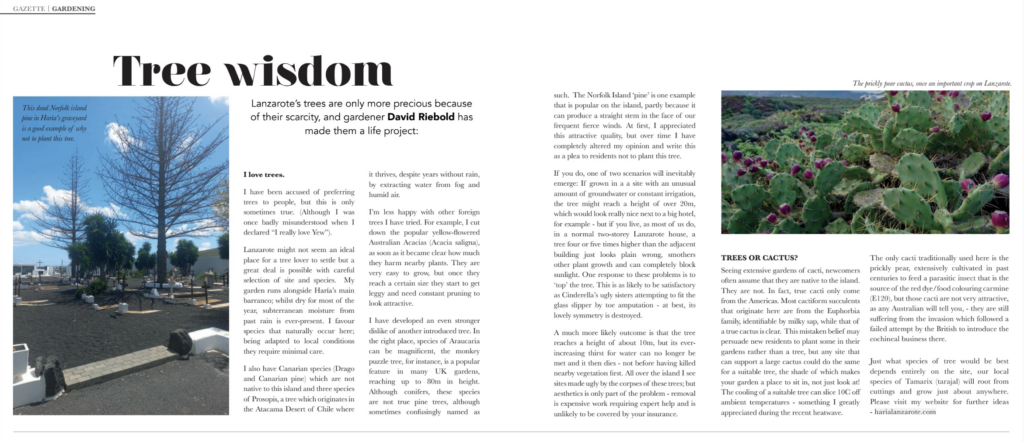
Lanzarote’s trees are only more precious because of their scarcity, and gardener David Riebold has made them a life project:
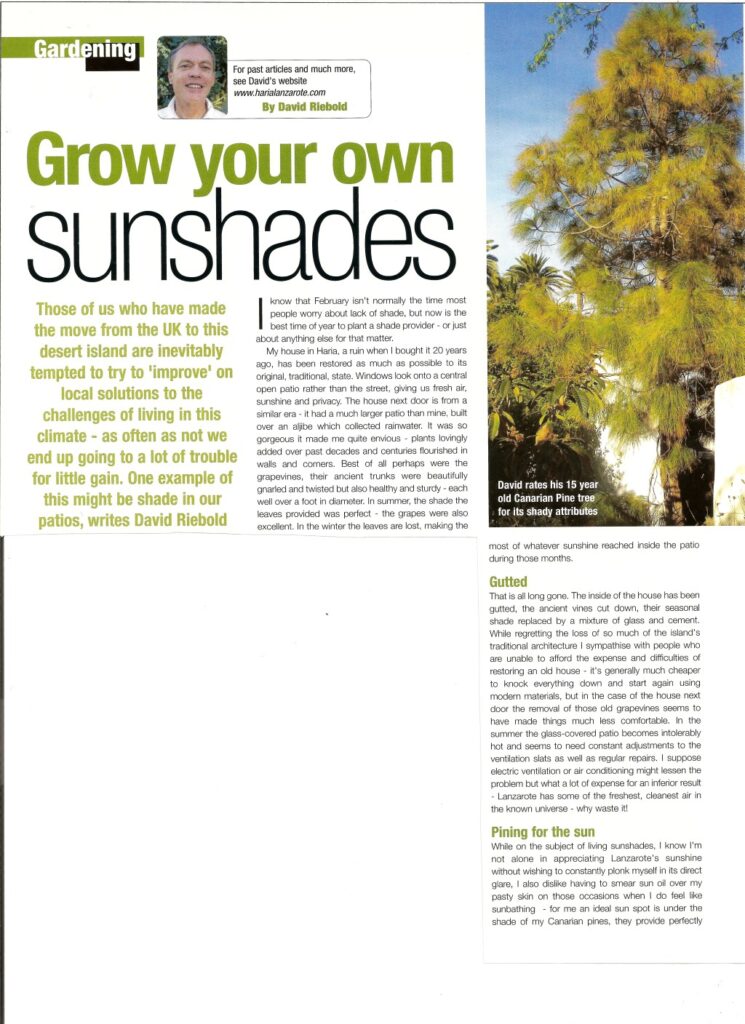
I love trees. I have been accused of preferring trees to people, but this is only sometimes true. (Although I was once badly misunderstood when I declared “I really love Yew”). Lanzarote might not seem an ideal place for a tree lover to settle but a great deal is possible with careful selection of site and species. My garden runs alongside Haría’s main barranco; whilst dry for most of the year, subterranean moisture from past rain is ever-present. I favour species that naturally occur here; being adapted to local conditions they require minimal care. I also have Canarian species Drago and Canarian pine which are not native to this island and three species of Prosopis, a tree which originates in the Atacama Desert of Chile where it thrives, despite years without rain, by extracting water from fog and humid air. I’m less happy with other foreign trees I have tried. For example, I cut down the popular yellow-flowered Australian Acacias (Acacia saligna), as soon as it became clear how much they harm nearby plants. They are very easy to grow, but once they reach a certain size they start to get leggy and need constant pruning to look attractive.
I have developed an even stronger dislike of another introduced tree. In the right place, species of Araucaria can be magnificent, the monkey puzzle tree, for instance, is a popular feature many UK gardens, reaching up to 80m in height. Although conifers, these species are not true pine trees, although sometimes confusingly named as The prickly pear cactus, once an important crop on Lanzarote. such. The Norfolk Island ‘pine’ is one example that is popular on the island, partly because it can produce a straight stem in the face of our frequent fierce winds. At first, I appreciated this attractive quality, but over time I have completely altered my opinion and write this as a plea to residents not to plant this tree. If you do, one of two scenarios will inevitably emerge: If grown in a a site with an unusual amount of groundwater or constant irrigation, the tree might reach a height of over 20m, which would look really nice next to a big hotel, for example – but if you live, as most of us do, in a normal two-storey Lanzarote house, a tree four or five times higher than the adjacent building just looks plain wrong, smothers other plant growth and can completely block sunlight. One response to these problems is to top’ the tree. This is as likely to be satisfactory as Cinderella’s ugly sisters attempting to fit the glass slipper by toe amputation – at best, its lovely symmetry is destroyed. A much more likely outcome is that the tree reaches a height of about 10m, but its ever-increasing thirst for water can no longer be met and it then dies- not before having killed nearby vegetation first. All over the island I see sites made ugly by the corpses of these trees; but aesthetics is only part of the problem – removal is expensive work requiring expert help and is unlikely to be covered by your insurance.
TREES OR CACTUS?
Seeing extensive gardens of cacti, newcomers often assume that they are native to the island. They are not. In fact, true cacti only come from the Americas. Most cactiform succulents that originate here are from the Euphorbia family, identifiable by milky sap, while that of a true cactus is clear. This mistaken belief may persuade new residents to plant some in their gardens rather than a tree, but any site that can support a large cactus could do the same for a suitable tree, the shade of which makes your garden a place to sit in, not just look at! The cooling of a suitable tree can slice 10C off ambient temperatures – something I greatly appreciated during the recent heatwave. The only cacti traditionally used here is the prickly pear, extensively cultivated in past centuries to feed a parasitic insect that is the source of the red dye/food colouring carmine (E120), but those cacti are not very attractive, as any Australian will tell you, – they are still suffering from the invasion which followed a failed attempt by the British to introduce the cochineal business there. Just what species of tree would be best depends entirely on the site, our local species of Tamarix (tarajal) will root from cuttings and grow just about anywhere.













 EN
EN  ES
ES